

A guide to unlocking your future.
Best for high school students, school counselors, youth programs, and parents looking for a structured way to start a conversation.
Inside
An 8.5 by 11 guided journal for young men and women, written for the years when everything feels like it is being decided at once.
The book is organized into five levels that walk backward and forward through a life. Level 1 covers ages 0 to 1. Level 2 covers ages 2 to 3. Level 3 covers ages 4 to 12. Level 4 covers ages 13 to 19. Level 5 covers ages 20 to 27. Looking back at earlier stages is deliberate. It helps a reader notice where a habit or a belief actually started, instead of assuming it has always been there.
Each level pairs reflection space with prompts and practical notes. There is room to write about a time your parents helped you through something hard, and room to write about what you want next. As the author frames it in the client materials, this is a partner in growth, self-discovery, and connection for readers working on confidence, stress, and relationships.
Can you feel the passion?
Best for boys and young men aged 12 and up, mentors, coaches, and fathers.
Inside
Direct, blunt, and written in the voice a young man might actually listen to.
The book is built in six segments that carry a reader from age 12 into his late twenties. Segment 1, the Wake-Up Call, covers ages 12 to 14 and starts where most boys actually are: a body that is changing faster than the confidence to match it. The advice is unglamorous on purpose. Social status is temporary. Hygiene is not optional. What you post follows you. Discipline outlasts talent.
Later segments push into resilience, competence, and character, with journaling prompts and a weekly habit tracker so the reading turns into something measurable. The prompts are short and repeatable. What is one thing you are proud of today? What is something you want to stop worrying about? What is one skill you want to master?
The premise running underneath it is that boys who mature later are not behind. They are building something on a slower clock.


Tune out the noise. Tune into your inner wisdom.
Best for girls and young women aged 12 and up, youth workers, and parents.
Inside
A diary that follows a young woman through adolescence and into her twenties, written in a voice that does not pretend to have everything sorted.
The book moves through five segments. Cultivating Your Mind covers ages 12 to 17. Loving Yourself First covers ages 18 to 23. Mind Matters covers ages 24 to 25. Building Bridges covers age 26. The final segment, Protect Yourself and Empower Your Life, closes the arc.
Along the way, it takes on social media pressure, questioning the guidance you were raised with, and the ordinary mess of figuring out who you are. The client summary describes it as a reminder that it is okay to not have it all figured out, and that real confidence is built from the inside rather than handed over by anyone else.
Safety, trust, awareness, and a structured beginning.
Best for therapeutic mentors, provider agencies, clinics, therapists, and caregivers working inside a structured program.
Inside
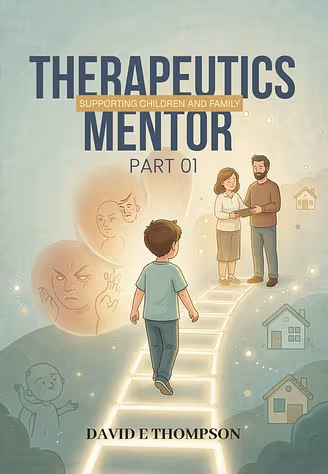
Part 1 of a two-part working guide for therapeutic mentors, parents, caregivers, therapists, providers, and support teams.
This is a practitioner’s book. It covers the mentor intake process, therapeutic alignment with the treatment plan, parent and caregiver engagement, early signs of social anxiety, empathy and perspective-taking, communication across home, school, and provider settings, and progress documentation throughout.
The core principles are stated early and repeated in practice. Safety comes before skill. The child should not feel blamed. Parents are partners, not outsiders. The mentor works with the therapeutic team. Activities help children express what words cannot. Progress must be documented as it happens, not reconstructed at the end.
Structurally, the book is both a reading text and a set of usable forms. Child activity sheets, mentor-guided activities, parent exercises, role-play scripts, provider communication templates, and TM Progress Notes are built into each section, so the work is documented as it is done.
From foundation into real-life application.
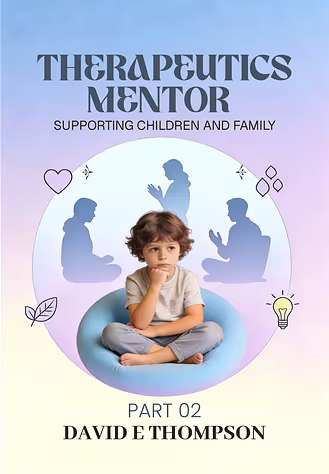
Best for mentors and teams continuing from Part 1, plus therapists and agencies handling progress review, discharge, and aftercare planning.
Inside
Part 2 takes the skills built in Part 1 and moves them out of the session room and into public spaces, classrooms, friendships, family life, and the community.
The chapters cover community confidence and public safety, small talk and focus, self-care and healthy friendships, scenario-based learning around trauma, grief, and belonging, diagnosis awareness and self-advocacy, subconscious patterns and internal dialogue, and a final growth review with discharge planning.
The section on diagnosis is the one many teams will reach for first. Its position is balanced and stated plainly. A diagnosis helps us understand. It does not remove responsibility, erase strengths, or define the whole child. It helps us choose better tools. The book then gives mentors a translation process for turning clinical language into words a child can hear without shame.
Graduation, in this framework, does not mean the child will never struggle again. It means the child leaves with more awareness, more language, more tools, and a clearer support plan than they arrived with.




01 SOCIAL-EMOTIONAL LEARNING
Social and Emotional Eye Skills
Understand your value. Understand your emotions. Understand your behavior.
Best for parents, art teachers, elementary classrooms, and mentors working with younger children.
Inside
A picture-led book for artistic children, built around one idea: a feeling is easier to handle once you can see it. The subtitle on the cover says it plainly. Emotional awareness, self-esteem, identity, and creativity, so they can recognize identity, value, and emotions.
Children who draw, build, and imagine often process the world visually long before they can explain it in sentences. This book meets them there. It gives young readers a shared vocabulary they can use with a parent, a teacher, or a mentor, so that naming a feeling stops being a test and starts being a normal part of the day.
book trailer